
Peptide research has become one of the most rapidly expanding areas of modern biotechnology, with scientists investigating naturally occurring signaling molecules and their potential roles in cellular communication, tissue maintenance, and regenerative biology.
Among the many compounds being studied, TB-500 has attracted considerable attention within research communities due to its relationship with Thymosin Beta-4 (Tβ4), a naturally occurring protein found throughout the body.
Researchers have explored TB-500 in a variety of experimental settings, investigating its involvement in cellular migration, tissue remodeling, angiogenesis, and cytoskeletal regulation. While research remains ongoing, TB-500 continues to be a subject of interest in regenerative biology and peptide science.
This article explores the scientific background of TB-500, its relationship to Thymosin Beta-4, the biological pathways that researchers are investigating, and why the peptide remains an important area of laboratory study.
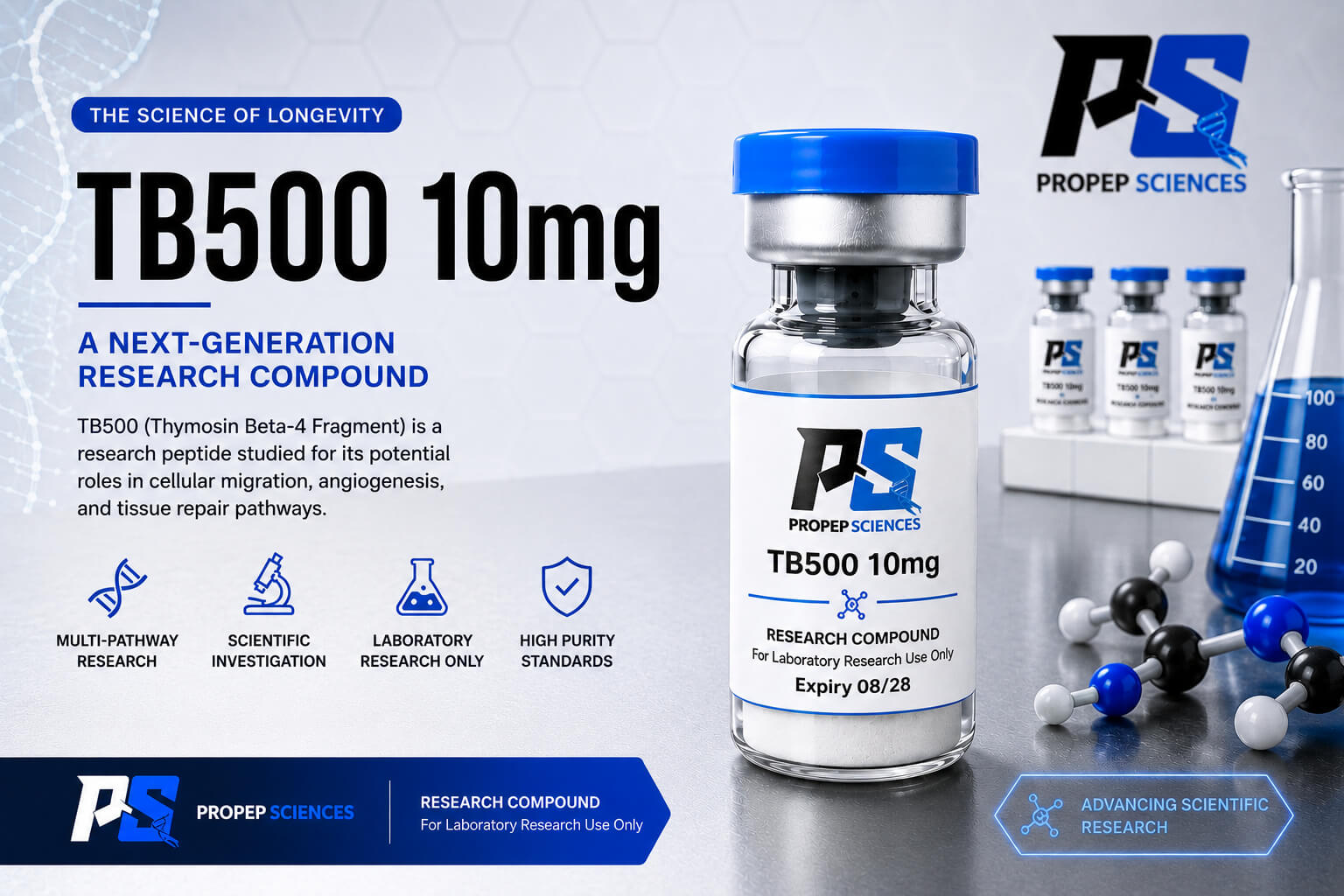
TB-500 is a synthetic peptide based on an active region of the naturally occurring protein Thymosin Beta-4.
Thymosin Beta-4 is a highly conserved peptide found in virtually all mammalian tissues and cells. It plays a role in numerous biological processes and has been extensively studied for its involvement in cellular organization and signaling pathways.
Because the full Thymosin Beta-4 molecule contains 43 amino acids, researchers developed smaller peptide fragments that could be investigated independently. TB-500 represents one such fragment and has become widely used within laboratory research environments.
Unlike larger proteins, smaller peptides may exhibit improved stability and distribution characteristics within experimental models, making them attractive tools for scientific investigation.
Thymosin Beta-4 was originally identified during investigations into thymic proteins and cellular regulation.
Over time, researchers discovered that Tβ4 was not limited to the thymus but was present throughout many tissues and cell types.
Scientific studies subsequently revealed that Thymosin Beta-4 appeared to participate in several fundamental biological processes, including:
These findings led researchers to investigate whether specific regions of the protein were responsible for particular biological activities.
TB-500 emerged from this line of investigation as a synthetic peptide designed to replicate certain aspects of Thymosin Beta-4 activity for laboratory research purposes.
To appreciate why researchers are interested in TB-500, it is useful to understand the role of peptide signaling molecules within biological systems.
Cells communicate continuously using chemical messengers that influence behaviour, movement, growth, and adaptation.
These signaling pathways help coordinate:
Peptides often act as messengers within these systems, allowing cells to respond to changing environmental conditions.
TB-500 is investigated within this context because of its potential relationship with pathways involved in cellular organisation and migration.
One of the most studied aspects of Thymosin Beta-4 biology is its interaction with actin.
Actin is one of the most abundant proteins found within cells and plays an essential role in:
Researchers have reported that Thymosin Beta-4 may influence the regulation of G-actin, a monomeric form of actin involved in cellular remodeling.
Because cellular migration requires constant restructuring of the cytoskeleton, understanding actin regulation remains an important area of biological research.
TB-500 has therefore become a useful research tool for investigating these processes.
Cellular migration is a critical biological process that occurs throughout life.
Researchers study cell migration because it contributes to:
Cells must move efficiently through tissues to perform their functions.
Experimental studies involving TB-500 have investigated how peptide signaling may influence the mechanisms that guide cellular movement and organisation.
Although much remains to be understood, these investigations continue to provide valuable insights into the complexity of cellular communication.
Another major area of scientific interest surrounding TB-500 is angiogenesis.
Angiogenesis refers to the formation of new blood vessels from existing vascular structures.
This process is important in numerous biological contexts and is regulated by highly complex signaling networks.
Researchers have explored whether Thymosin Beta-4-related pathways may interact with factors involved in vascular development and tissue remodeling.
As a result, TB-500 has been investigated in experimental models examining:
The precise mechanisms remain an active area of research.
Regenerative biology focuses on understanding how tissues maintain, repair, and reorganize themselves over time.
Scientists investigating regenerative processes often examine:
TB-500 has attracted interest within this field because of its association with biological processes involved in tissue maintenance and remodeling.
While significant research remains ongoing, regenerative biology continues to represent one of the most active areas of peptide research.
Peptides have become increasingly important in biotechnology due to their specificity and biological relevance.
Compared with many traditional compounds, peptides can interact with biological targets in highly precise ways.
Researchers investigate peptides because they may:
TB-500 forms part of a broader category of research compounds that allow scientists to examine how cells coordinate their responses to environmental challenges.
The peptide research sector has expanded significantly over the last decade.
Advances in peptide synthesis, purification technologies, and analytical methods have enabled researchers to investigate increasingly complex biological questions.
Today, peptide research spans numerous scientific disciplines, including:
TB-500 remains one of the most recognised compounds within regenerative peptide research.
Researchers require high-quality compounds to ensure consistency and reliability.
Important quality parameters often include:
High-performance liquid chromatography (HPLC) is commonly used to verify peptide purity.
Mass spectrometry may be employed to confirm molecular composition.
Proper storage conditions are essential for maintaining peptide integrity.
Researchers typically follow established laboratory protocols to minimise degradation and contamination.
These considerations are important for any peptide-based research programme.
Product Name: TB-500
Alternative Name: Thymosin Beta-4 Fragment
Peptide Sequence: Ac-LKKTETQ
Appearance: White Lyophilised Powder
Purity: ≥99% (HPLC)
Research Category: Regenerative Biology Research
Storage Recommendations:
The scientific understanding of peptide biology continues to evolve.
As research techniques improve and new experimental models become available, investigators are likely to gain deeper insights into the mechanisms associated with Thymosin Beta-4 and related compounds.
Future areas of investigation may include:
The ongoing study of these pathways may contribute to a broader understanding of biological adaptation and maintenance.
B-500 is a synthetic peptide derived from Thymosin Beta-4 that continues to generate significant interest within the scientific community.
Researchers have explored its relationship with cellular migration, cytoskeletal organisation, angiogenesis, and tissue remodeling, making it an important compound within regenerative biology research.
While many questions remain under investigation, TB-500 serves as a valuable tool for scientists seeking to better understand the complex signaling pathways that govern cellular behaviour.
As peptide science continues to advance, TB-500 is likely to remain a prominent subject of laboratory research and scientific exploration.
TB-500 supplied by Propep Sciences is intended strictly for laboratory research purposes only.
This product is not intended for human consumption, veterinary use, diagnosis, treatment, cure, mitigation, or prevention of any disease or medical condition.
Researchers are responsible for ensuring compliance with all applicable laws, regulations, and institutional guidelines within their jurisdiction.